




The United States is millions of homes short of what is needed to meet long-term housing demand, a deficit that has made affordability a persistent challenge for both buyers and renters. Redfin estimates the national housing shortage at 4.03 million units, reflecting years in which residential construction failed to keep pace with household growth. When housing is scarce, households compete for a limited number of available homes, putting upward pressure on both prices and rents. The effects extend beyond monthly housing costs: limited inventory can make it harder for first-time buyers to enter the market, constrain where workers can afford to live, and leave lower-income renters particularly exposed to housing instability.
That shortage has also intensified debate over how the nation’s existing housing stock is used. Policymakers have scrutinized institutional purchases of single-family homes, while many communities have imposed restrictions on short-term rentals amid concerns about homes shifting from residential to visitor use. Vacation homes raise a related but more complicated question. A second home used by a single household for only part of the year can reduce the housing available to year-round residents, particularly in communities with limited supply. While single-household vacation homes can strain local inventory, shared ownership models like timeshares offer a different equation. By accommodating multiple owners within the same property and often concentrating vacation demand in resort developments or commercially oriented areas, they absorb vacation demand without depleting the conventional housing stock.
Conducted by researchers at SellMyTimeshareNow—a global marketplace connecting people around the world to rent, buy, and sell timeshares—this analysis examines the geography and changing prevalence of vacation homes in the United States. It tracks vacation homeownership over time, compares the occupancy of shared vacation properties with traditional hotels, and identifies the states and cities where vacation homes make up the largest shares of the housing stock. Together, these measures provide a clearer picture of where vacation housing is concentrated and how different approaches to accommodating vacation demand intersect with the broader challenge of housing supply.
Here are the key takeaways from the analysis:
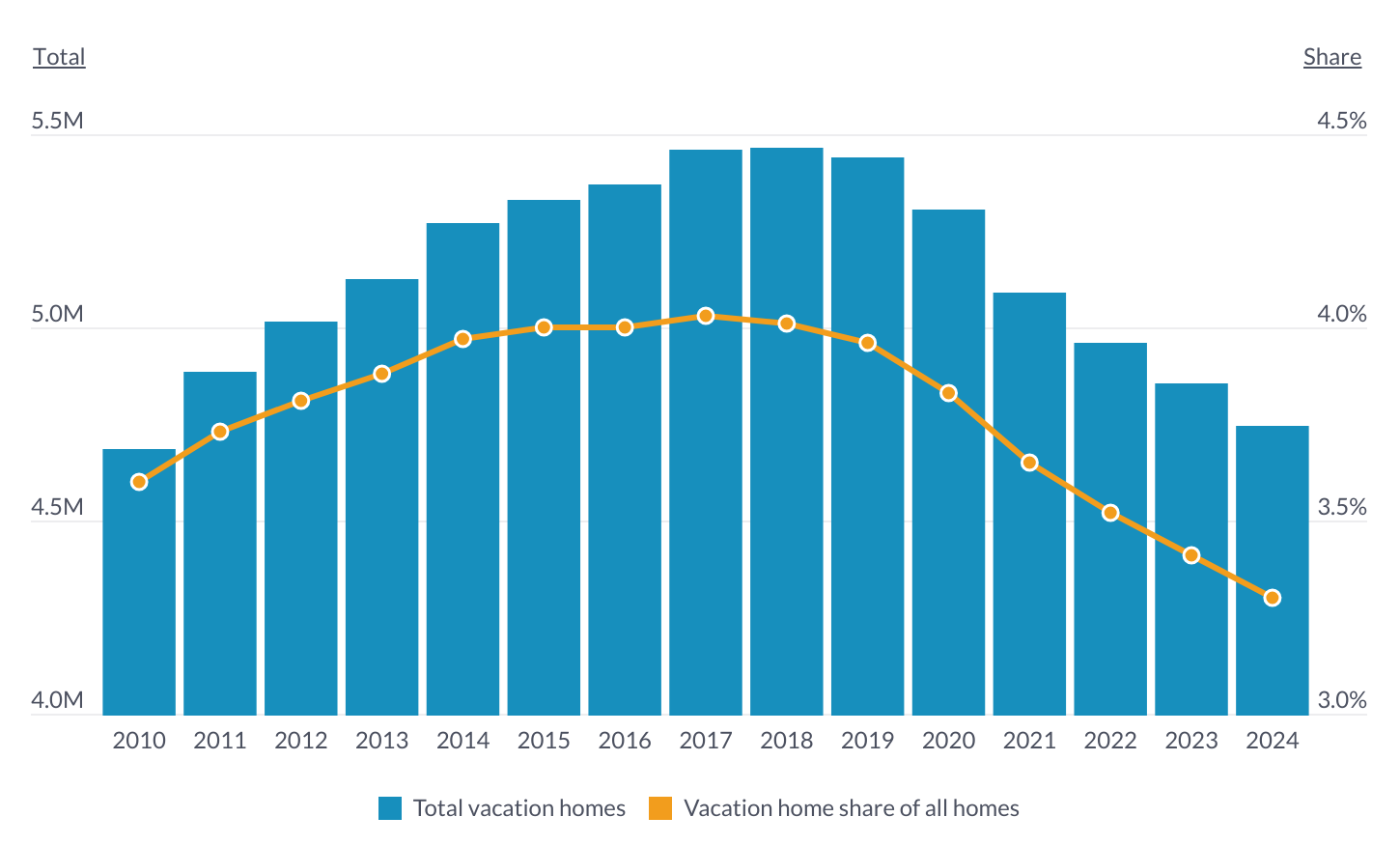
- Vacation homeownership has declined steadily since its 2018 peak. The number of vacation homes fell from 5.47 million in 2018 to 4.74 million in 2024, while their share of the U.S. housing stock dropped from 4.0% to 3.3%.
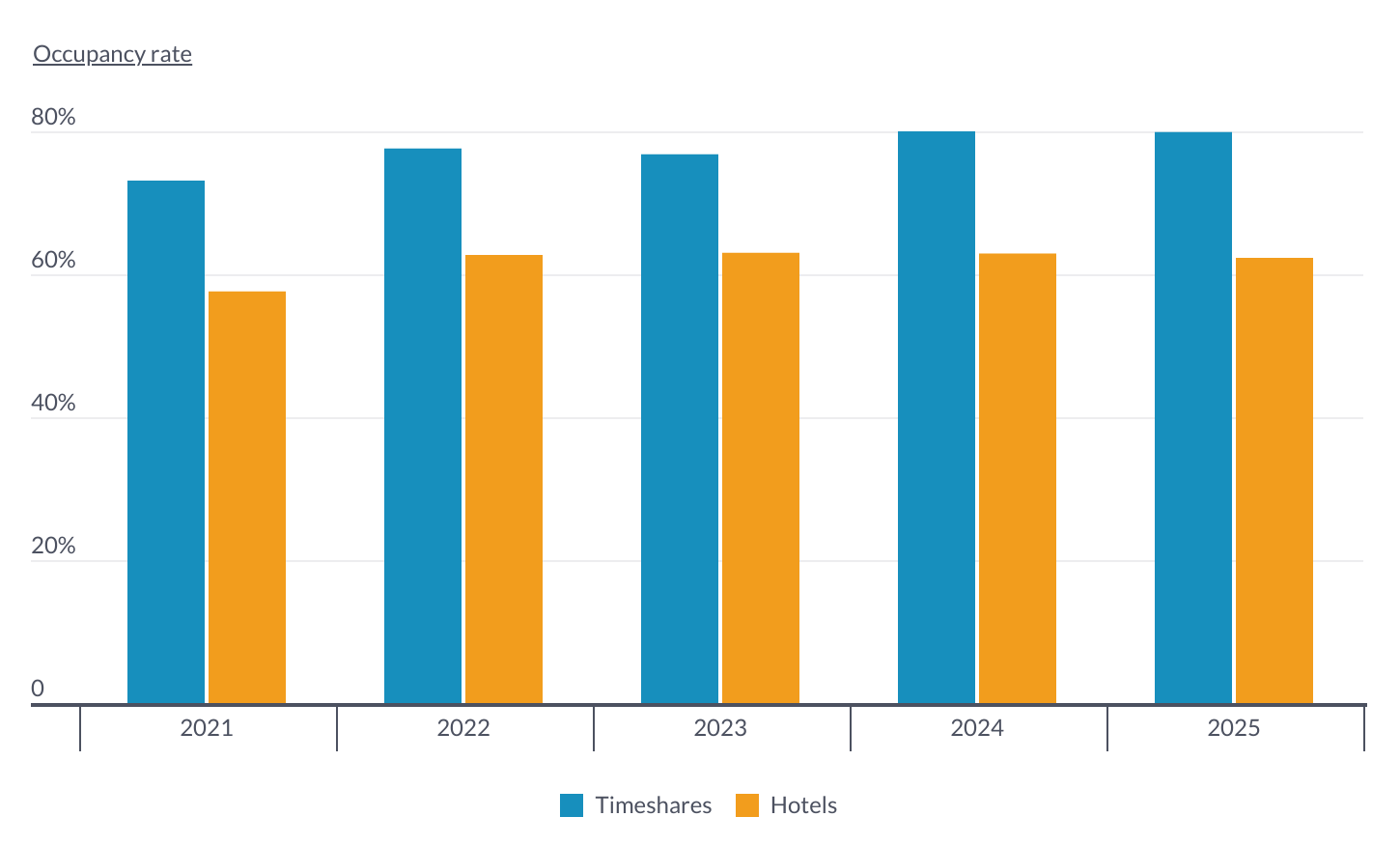
- Timeshares maintain substantially higher occupancy than hotels and second homes. In 2025, timeshare occupancy reached 79.9%, nearly 18 percentage points higher than the 62.3% hotel rate, highlighting the higher utilization of shared vacation properties.
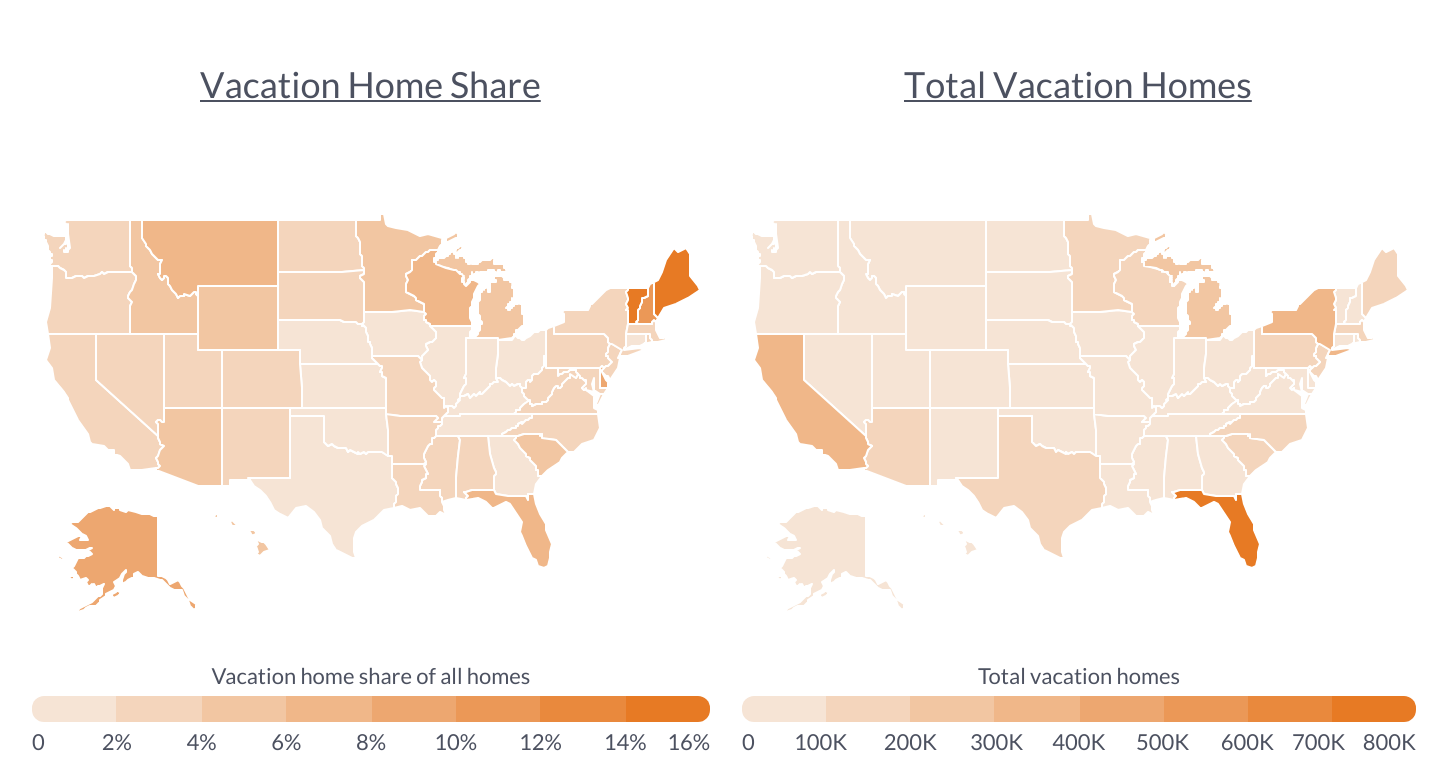
- Florida has the most vacation homes, while northern New England leads in concentration. Florida has over 802,000 vacation homes, but Maine and Vermont have the largest shares of their housing stock devoted to vacation use, at 15.3% and 14.7%, respectively.
- Vacation homes can account for more than half of the housing stock in resort communities. Nantucket (55.0%), Vineyard Haven (54.4%), and Ocean Pines (52.6%) lead the smallest U.S. metros, underscoring how concentrated vacation housing can become in tourism-oriented markets.
Trends in Vacation Homeownership Over Time
After peaking in 2018, vacation homeownership has declined every year since
Source: SellMyTimeshareNow analysis of U.S. Census Bureau data | Image Credit: SellMyTimeshareNow
Vacation homes became an increasingly common part of the U.S. housing stock through much of the 2010s, but that trend has since reversed. The number of vacation homes—those defined by the U.S. Census Bureau as used for seasonal, recreational, or occasional purposes—rose from 4.68 million in 2010 to a peak of 5.47 million in 2018, an increase of nearly 17%. Since then, the total has declined every year, falling to 4.74 million in 2024. As a share of the nation’s housing stock, vacation homes followed a similar trajectory, climbing from 3.6% in 2010 to roughly 4.0% during the latter half of the decade before declining to 3.3% in 2024.
Several economic shifts have made owning a vacation home less attractive or attainable in recent years. Higher mortgage rates and elevated home prices have substantially increased the cost of purchasing and carrying a second property. At the same time, the return to in-person work has reduced some of the geographic flexibility that helped fuel demand for vacation homes during the pandemic. Because second homes are generally discretionary purchases, demand can be particularly sensitive to these changes in affordability and lifestyle. Recent analysis of federal mortgage data illustrates the scale of the pullback: purchases of second homes using a mortgage fell nearly 66% from their pandemic-era peak in 2021 to 2025.
Are Shared Vacation Homes More Efficient Than Standard Lodging?
Timeshares average 80% occupancy, outperforming hotels while focusing vacation demand in resort zones
Source: SellMyTimeshareNow analysis of ARDA’s 2026 State of the Vacation Timeshare Industry and Costar data | Image Credit: SellMyTimeshareNow
As traditional vacation homeownership has declined, shared ownership models offer a different approach to meeting demand for second-home use. Individually owned vacation homes are, by their nature, used only periodically by their owners, meaning they can remain unoccupied for substantial portions of the year. Timeshares instead divide access to the same property among multiple owners, allowing one household’s unused time to become another household’s vacation stay. That structure can translate into substantially higher utilization: in 2025, U.S. timeshare occupancy stood at 79.9%, compared with 62.3% for hotels, a gap of nearly 18 percentage points.
In that respect, timeshares can occupy a middle ground between individually owned vacation homes and traditional hotels. Like a vacation home, they provide owners with recurring access to resort accommodations, often with more space and residential-style amenities than a standard hotel room. But like hotels, the same inventory can accommodate a succession of guests throughout the year, rather than sitting unused when an individual owner is away. Their nearly 80% occupancy rate suggests that this shared model can make intensive use of vacation-oriented real estate while serving multiple households. And when timeshares are built as dedicated resort accommodations, they can help concentrate tourism demand in properties intended for visitors rather than relying exclusively on homes that could otherwise serve year-round residents.
Which States Have the Most Vacation Homes?
Florida has the most vacation homes by volume, while Maine and Vermont lead in concentration
Source: SellMyTimeshareNow analysis of U.S. Census Bureau data | Image Credit: SellMyTimeshareNow
Vacation homes are not distributed evenly across the country, and the states with the largest numbers are not necessarily those where they have the greatest presence in the housing market. Florida has more vacation homes than any other state, with roughly 802,000, reflecting both its large population and its role as a major destination for seasonal residents and tourists. California ranks a distant second with about 358,000, followed by New York with 301,000 and Michigan with 254,000. Yet vacation homes account for just 7.8% of Florida’s housing stock and considerably smaller shares in California and New York, illustrating how raw totals can obscure their relative importance within local housing markets.
By concentration, northern New England stands out most clearly. Vacation homes account for 15.3% of all housing units in Maine and 14.7% in Vermont—the two highest shares in the country—while neighboring New Hampshire ranks third at 10.1%. Together, the three states form a distinct regional cluster where seasonal and recreational housing represents an unusually large portion of the overall housing supply. Outside New England, high concentrations appear in states with established coastal, mountain, or outdoor recreation economies, including Alaska (8.6%), Delaware (8.5%), Florida (7.8%), Montana (6.8%), Wisconsin (6.2%), Idaho (5.8%), and Hawaii (5.6%).
At the metro level, vacation homes are even more concentrated in places built around tourism and seasonal recreation. Among the nation’s smallest metros, Nantucket, Massachusetts, has the highest share, with vacation homes accounting for 55.0% of its housing stock, followed closely by Vineyard Haven, Massachusetts, at 54.4% and Ocean Pines, Maryland, at 52.6%. Mountain destinations also rank prominently, including Breckenridge, Colorado, where 45.8% of homes are used for seasonal, recreational, or occasional purposes. The pattern extends to larger markets as well: Barnstable Town, Massachusetts, leads small metros at 33.1%, while Atlantic City-Hammonton, New Jersey, tops midsize metros at 28.7%. Among the largest metropolitan areas, the shares are considerably lower, but vacation destinations still dominate the rankings. Miami, Florida, leads at 6.8%, followed by the Riverside, California, metro area—home to popular desert vacation destination Palm Springs—at 5.8% and Tampa, Florida, at 5.4%. Overall, the rankings show that vacation homes are most prominent in coastal and mountain destinations, with their share of local housing generally increasing as markets become smaller and more tourism-dependent.
For complete results, see U.S. Cities and States With the Most Vacation Homes on SellMyTimeshareNow.
Methodology

Photo Credit: Just Dance / Shutterstock
Researchers at SellMyTimeshareNow analyzed the latest data from the U.S. Census Bureau’s 2024 American Community Survey to determine the locations with the most vacation homes. The researchers ranked locations according to the share of vacation homes compared to all homes in each location. Vacation homes were considered to be homes that are for seasonal, recreational, or occasional use, as defined by the U.S. Census Bureau.
In the event of a tie, the location with the larger total vacation homes was ranked higher. For context, researchers also calculated the total number of homes, the median home price to income ratio, and the share of renters that are cost burdened in each location.
Only records with complete data were included in the analysis. To improve relevance, metro areas—which include both metropolitan and micropolitan areas—were grouped into the following cohorts based on population size:
- Large metros: 1,000,000 or more
- Midsize metros: 350,000–999,999
- Small metros: 100,000–349,999
- Extra small metros: less than 100,000
For complete results, see U.S. Cities and States With the Most Vacation Homes on SellMyTimeshareNow.